Finland’s engineering talent powering a new industrial era
Finland has always been a nation of builders and problem-solvers. But the new TechSkillsAtlas™ 2026 study shows just how far that heritage extends in the era of Industry 4.0. Engineering excellence is an important part of the Finnish economy and the country’s largest technical resource base, with a scale that often surprises international investors.
News 8.4.2026

Compiled by the international consultancy MCJ Lemagnen Associates, the TechSkillsAtlas™ Finland 2026 study shows that the country’s Engineering, ICT, Healthtech, and Cleantech sectors are home to exceptional talent and specialist expertise.
According to the study, Finland has a core engineering workforce of 219,000 professionals working in technical roles right now. It is by far the biggest of the four skills areas measured. And when you add those with engineering skills who are not currently working in engineering roles, the total almost doubles.
Michel Lemagnen, CEO and founder of MCJ Lemagnen Associates, stresses the significance. “Lapsed talent is a huge opportunity in Finland. A very large share of these professionals still want to work in technical roles. With the right incentives, companies can access an enormous additional resource.”
Finland’s engineering might isn’t just about numbers. The study identified its capabilities across electrical, mechanical, industrial and manufacturing engineering, as well as expert niches in industries such as automotive, mining, electronics, telecoms, and shipbuilding.
Specialists across the engineering spectrum
When it comes to specialisms, Finland has a range that few countries can match. The study maps 61 major engineering specializations, from mainstream fields like electronics and power management to niche areas including autonomous systems, drone technologies, satellite systems and advanced radar and sensing technologies.
Lemagnen finds this especially noteworthy. “Finland’s engineering base is both broad and deep. You see huge resource pools in traditional fields, but also strong capability in emerging systems and future technologies.”
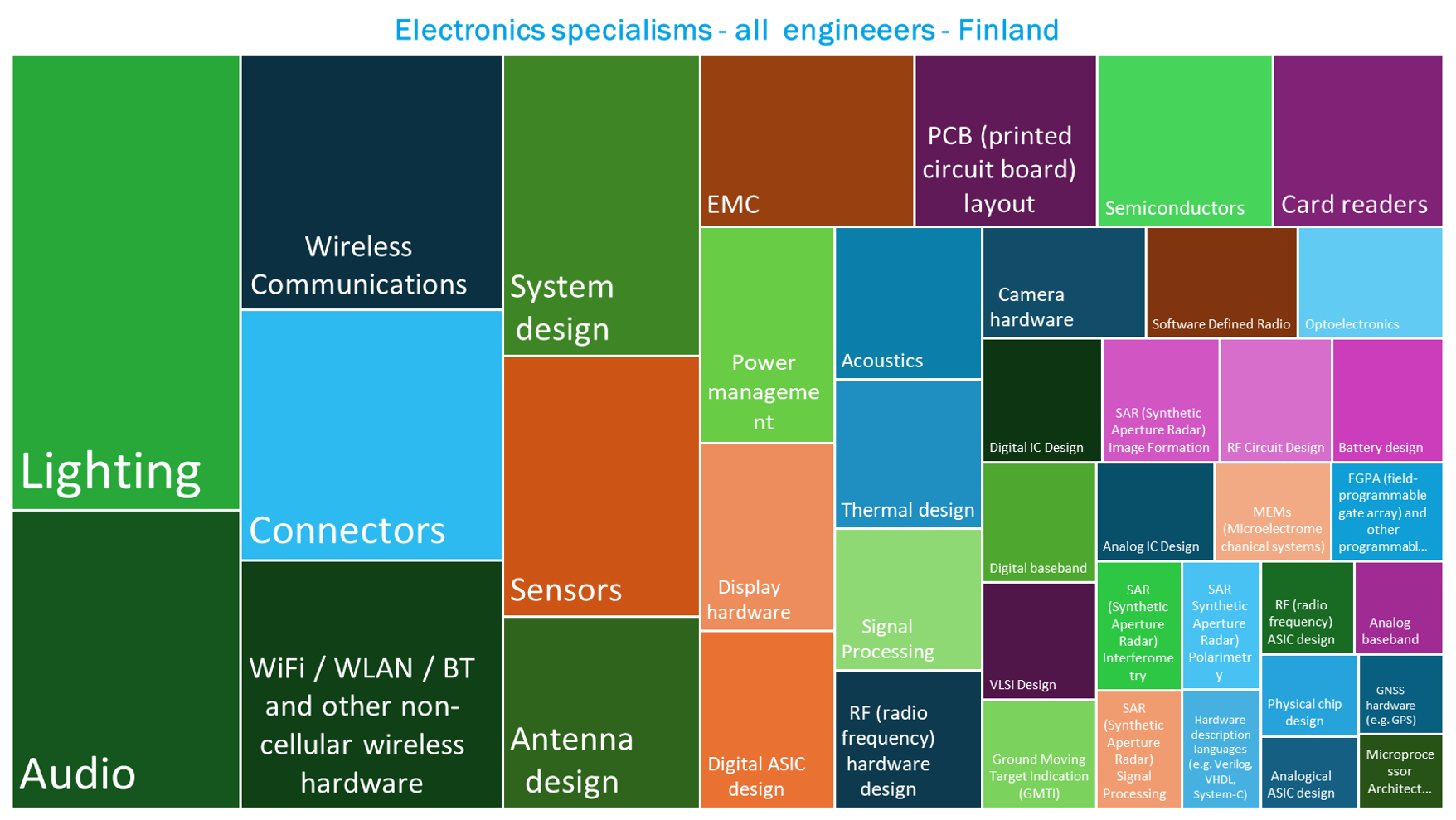
This hybrid of heritage and innovation is one reason engineering remains such a powerful driver of Finland’s competitiveness.
Even the most traditional sectors, like forestry and paper industries, have embraced advanced manufacturing and new industrial technologies. Turku’s world‑class cruise ship expertise, Vaasa’s energy‑technology cluster, and Helsinki’s icebreaker engineering are well‑known examples of this continuous evolution.
Interdisciplinary experience meets education
Engineering stands out as the largest of all the skills areas measured. The field spans a vast range of roles, from technicians and mechanics to professionals with master’s degrees and doctorates. And Finland’s engineers are not tied to one sector.
The study highlights strong interdisciplinary overlap between engineering, ICT and cleantech – particularly in automation, energy systems, electrification, robotics and Cleantech technologies. This cross-pollination strengthens Finland’s position in fast-growing industries such as electrified mobility, climate tech, smart manufacturing and industrial AI.
Engineering also boasts a rich mix of experience. Over half have worked in engineering roles for more than a decade, and 9% are aged 18–24, ensuring a steady pipeline for the sector’s future. Each year, Finland produces 31,000 new engineering graduates across both tertiary and vocational education.
Foreign companies play a big role
One finding that may surprise international investors is that engineering in Finland is highly global. While foreign companies make up only 2% of all enterprises in the Helsinki capital region, they employ almost a third of the region’s engineering workforce and contribute significantly to R&D, according to the study.
Western Finland, including the major regional hub of Tampere, is a true engineering powerhouse. The region hosts three in ten (29%) of all core engineers, with especially strong concentrations in advanced manufacturing and industrial technologies.
Regional strengths run deeper still, with pockets of highly specialized engineering expertise across the country – even in small counties. “Many countries have a big-city concentration,” Lemagnen explains. “Finland certainly has major hubs, but engineering talent is far more geographically balanced here than people imagine.”
Finland is future-ready
Take all these elements together – the size of the workforce, the regional balance, the scale of expertise, the foreign-company footprint, the educational base and the massive lapsed resource – and the message is clear: Finland has a strong abundance of engineering capability.
It supports heavy industry and cutting-edge R&D. It can respond to surges in demand. It supplies talent to global corporations while nurturing local champions. From electrification to advanced manufacturing to space-age engineering niches, it is innovative, adaptable, and scalable.
As Lemagnen puts it, “Engineering is part of Finland’s industrial DNA. What we see in the 2026 study is a talent base fully equipped for the next wave of industrial transformation.” For companies looking to build, design, manufacture, or invent, the nation offers one of the most future-ready engineering ecosystems anywhere.
TechSkillsAtlas™ Finland 2026
- TechSkillsAtlas™ is a technical skills measurement method created by MCJ Lemagnen Associates.
- The methodology was originally designed, tested, and developed by CEO Michel Lemagnen in 2006.
- MCJ Lemagnen Associates is a UK-headquartered, independent consulting and research firm, specializing in the fields of foreign direct investment and trade, economic development and research.
- The TechSkillsAtlas™ 2026 fieldwork in Finland was carried out by MCJ Lemagnen Associates’ Finnish and global fieldwork partner Verian, a division of one of the world’s largest insights companies.
- TechSkillsAtlas™ covers highly specialist technical skills, focusing on what people do now in their work and what they did in the past.
- Offers robust statistical information based on a quantitative, nationally and regionally representative web-based survey.
- 4,130 interviews conducted across mainland Finland; age range 18–64, including employed, self-employed and unemployed people. The survey excludes those in full-time education and individuals unable to work.
- The TechSkillsAtlas™ Finland 2026 was co-funded by Business Finland, Business Tampere and the Regional Council of North Karelia.
More information

Contact me
kaija.laitinen (at) businessfinland.fi
+358 40 822 0613